
Objective
The primary objective of this project was to develop a Digital Twin platform that mirrors physical assets and operational environments in a virtual space. The organization needed deeper visibility into system performance and the ability to simulate scenarios without impacting real-world operations.
Existing monitoring tools provided limited insights and lacked predictive capabilities. The goal was to create a system that combines real-time data with simulation models to enable proactive decision-making.
Additionally, the project aimed to enhance operational efficiency, reduce downtime, and support future innovations through a scalable and intelligent digital infrastructure.
Customer Requirements
Monitoring & Simulation Requirements
Real-time asset monitoring
The platform was designed to continuously track physical systems, equipment, and operational parameters in real time. This ensured accurate visibility into system performance and enabled timely decision-making.
Digital twin simulation
A digital twin model was implemented to simulate real-world conditions and system behavior. This allowed testing of scenarios, optimization strategies, and risk analysis without impacting live operations.
Predictive insights
Advanced analytics were used to forecast potential failures and performance issues. This enabled proactive maintenance, reduced downtime, and improved overall system efficiency.
Operational Requirements
Integration with IoT devices
The platform was integrated with sensors and connected IoT devices to collect real-time data from physical systems. This ensured accurate, continuous data flow for monitoring and analysis.
Scalability
The system was designed to support multiple assets, devices, and environments across operations. This enabled seamless expansion while maintaining consistent performance.
High-performance processing
The platform was built to efficiently process large volumes of real-time data streams. This ensured low latency, fast insights, and responsive system behavior.
Integration with IoT devices
The platform was integrated with sensors and connected IoT devices to collect real-time data from physical systems. This ensured accurate, continuous data streams for monitoring and analysis.
Scalability
The system was designed to support multiple assets, devices, and operational environments. This enabled seamless expansion across use cases while maintaining consistent performance.
High-performance processing
The platform was built to process large volumes of real-time data efficiently using optimized data pipelines. This ensured low latency, fast insights, and responsive system behavior.
Data & Security Requirements
Secure data handling
Data from IoT devices and connected systems was securely transmitted and stored using encryption and access control mechanisms. This ensured data protection, integrity, and compliance with security standards.
Data visualization
Complex real-time data was presented through intuitive dashboards and visual interfaces. This enabled users to quickly interpret insights, monitor system status, and make informed decisions.
User Experience
Interactive 3D/visual interface
The platform provided an interactive 3D and visual representation of assets and systems in real time. This improved usability, enhanced situational awareness, and enabled intuitive understanding of complex operations.
Real-time alerts and notifications
The system generated instant alerts and notifications for anomalies, threshold breaches, and critical events. This ensured timely intervention, reduced risk, and improved operational responsiveness.
Our Solution
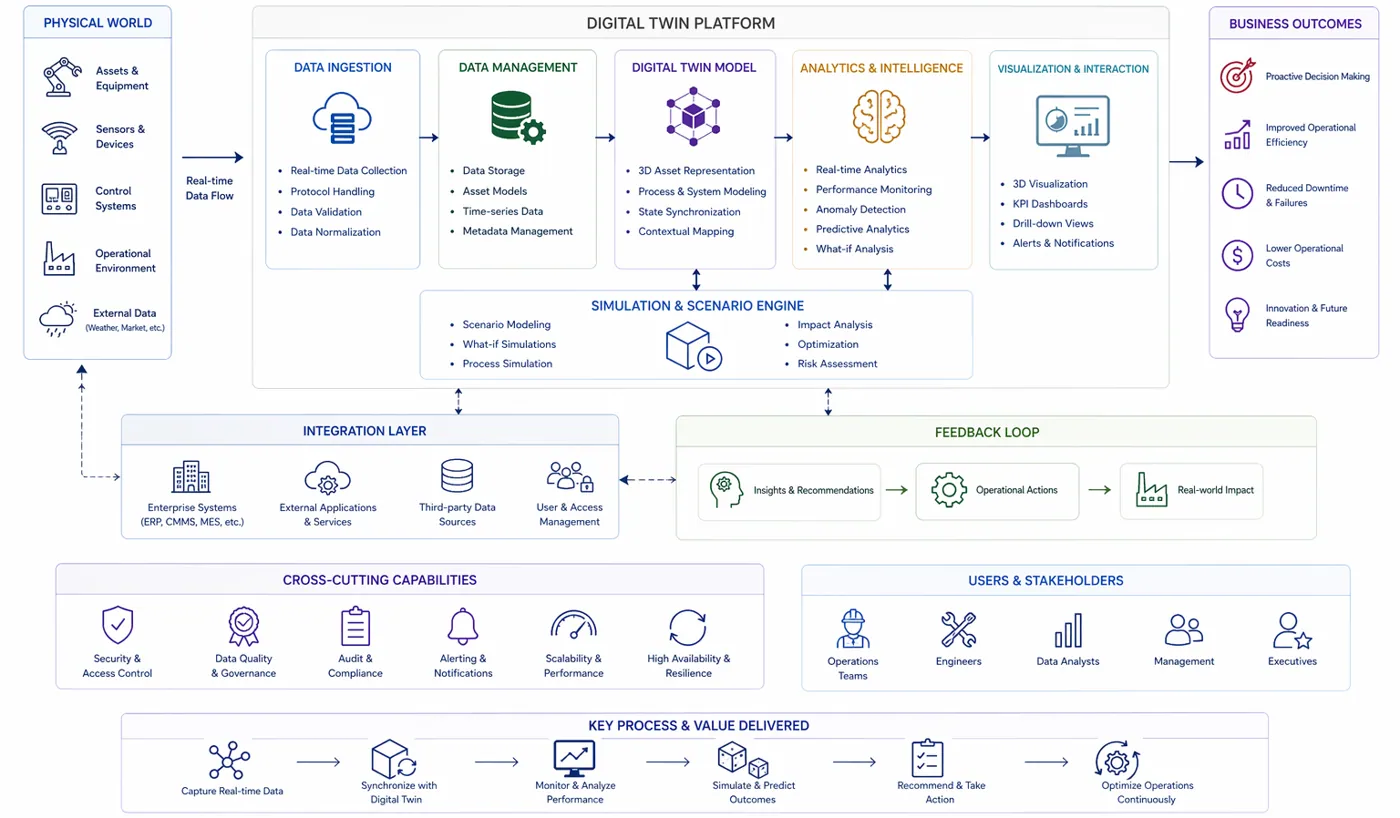
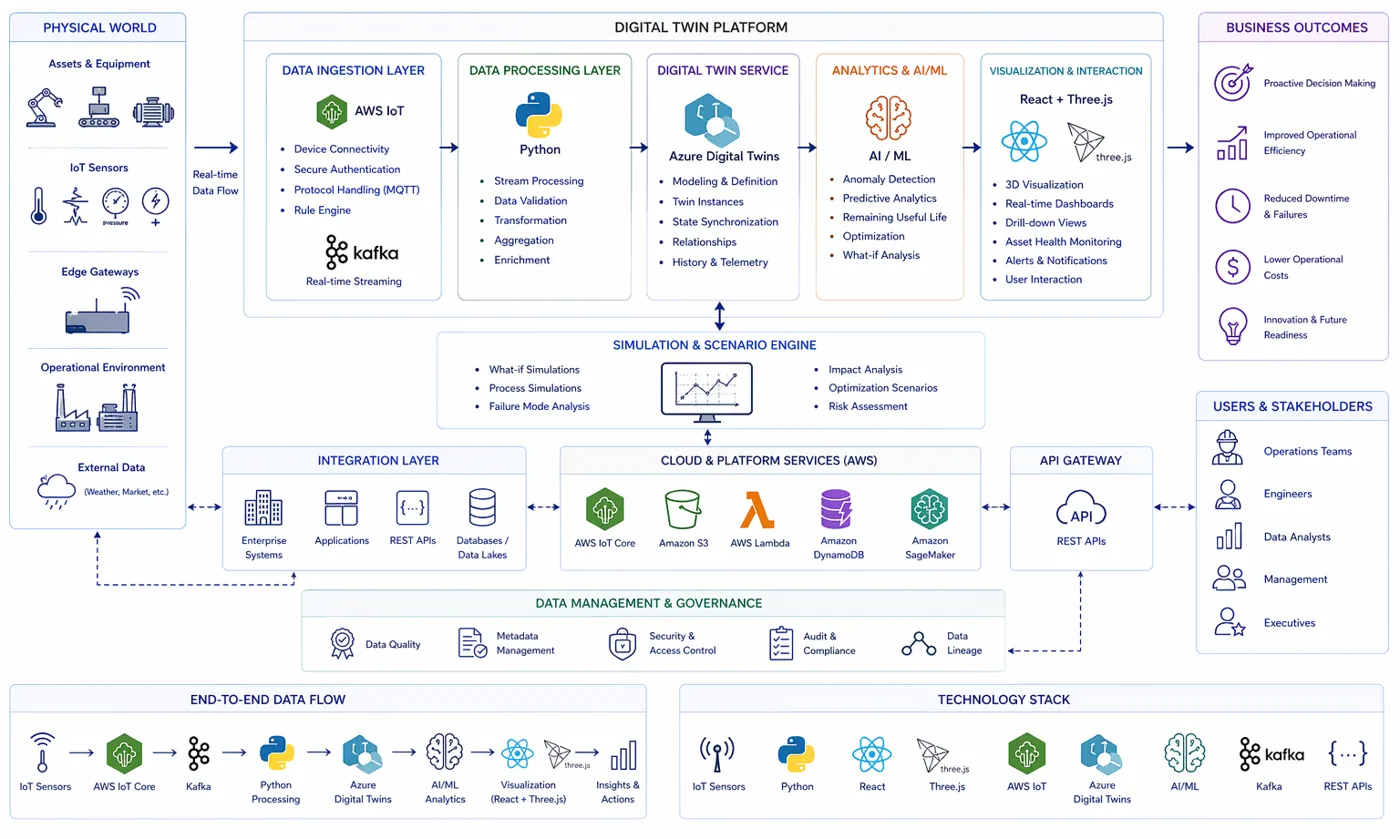
We developed an advanced Digital Twin platform that integrates IoT data, simulation models, and analytics to provide real-time insights and predictive capabilities.
Digital Twin Engine
Virtual models of physical assets were created using real-time data streams. This enabled accurate simulation, monitoring, and synchronization between physical and digital environments.
IoT Integration Layer
Sensors and connected devices were integrated to continuously collect and transmit operational data. This ensured real-time data synchronization and seamless communication across systems.
Simulation & Modeling
Advanced simulation models were implemented to test various scenarios and system behaviors. This supported proactive planning, optimization, and risk mitigation without impacting live operations.
Analytics & Visualization Dashboard
Interactive dashboards provided real-time insights into system performance and operational metrics. This enabled users to monitor, analyze, and optimize processes effectively.
AI-Based Predictive Analysis
Machine learning models analyzed historical and real-time data to identify patterns and predict potential failures. This reduced downtime, optimized maintenance schedules, and improved operational efficiency.
Secure & Scalable Architecture
The platform was built on a cloud-based architecture with robust security and access control mechanisms. This ensured high availability, data protection, and scalability for future expansion.
Technologies Used
Key Outcomes
The implementation provided real-time visibility into physical systems and significantly improved operational efficiency. It enabled predictive maintenance, reduced downtime, and enhanced decision-making accuracy.
Additionally, the digital twin approach supported innovation by allowing safe simulation of various scenarios without impacting live operations.
The solution also optimized resource utilization, reduced maintenance costs, and improved asset lifecycle management. Real-time insights and analytics enabled faster response to anomalies and better planning across operations.
Overall, the platform established a data-driven operational model, enabling continuous improvement and long-term scalability.
Conclusion
The Digital Twin platform successfully introduced a new level of intelligence and visibility into operations. It transformed traditional monitoring into a predictive and simulation-driven approach. The solution provides a future-ready foundation for advanced analytics, automation, and continuous innovation.
It also enabled seamless integration with existing enterprise systems and IoT ecosystems, ensuring a unified and scalable operational environment. This positions the organization to continuously evolve its capabilities and leverage emerging technologies for sustained growth and efficiency.