Objective
The primary objective of this project was to design and build a scalable Software-as-a-Service (SaaS) platform capable of supporting multiple tenants within a single architecture. The client aimed to transition from a traditional application model to a subscription-based product offering.
The goal was to create a flexible and secure platform that allows multiple customers to use the same system while maintaining data isolation, customization, and performance efficiency.
Additionally, the project focused on enabling rapid onboarding, automated billing, and seamless updates, ensuring continuous delivery of features without disrupting end users.
Customer Requirements
Platform Requirements
Multi-tenant architecture
The platform was designed to support multiple clients within a single system using a secure multi-tenant architecture. This ensured data isolation, tenant-specific configurations, and efficient resource utilization across all users.
Scalable infrastructure
The system was built on a scalable infrastructure capable of handling increasing users, transactions, and data volumes. This ensured consistent performance and reliability as the product expanded.
Modular design
A modular architecture was implemented to allow flexible addition of new features and services. This supported continuous product evolution, faster development cycles, and easier maintenance.
Operational Requirements
Subscription-based billing
The platform was designed to support multiple pricing plans, billing cycles, and subscription models. This enabled recurring revenue generation and flexible pricing strategies for different customer segments.
User onboarding & account management
A streamlined onboarding process was implemented to allow users to quickly set up and start using the platform. This improved user adoption, reduced friction, and enhanced overall customer experience.
Usage tracking
The system tracked user activity and feature usage across the platform. This supported accurate billing, provided actionable insights, and enabled data-driven product improvements.
Security & Compliance Requirements
High availability
The platform was designed to ensure continuous availability with minimal downtime through reliable and fault-tolerant infrastructure. This maintained consistent user access and protected customer experience across all tenants.
Automated updates
Deployment processes were automated to roll out updates seamlessly without disrupting active users. This enabled continuous product improvements while ensuring stability and a smooth user experience.
User Experience
Responsive and intuitive UI
The platform was designed with a clean, responsive, and user-friendly interface to ensure seamless usability across devices. This improved user engagement, reduced learning curve, and enhanced overall user experience.
Role-based access control
Role-based access mechanisms were implemented to provide different levels of permissions based on user roles. This ensured secure data access, proper governance, and controlled usage across the platform.
Our Solution
We developed a cloud-native SaaS platform using a multi-tenant architecture, enabling secure, scalable, and efficient delivery of services to multiple customers.
Multi-Tenant Architecture
The platform was built on a shared infrastructure with logical data isolation for each tenant. This ensured secure data separation while optimizing resource utilization and operational efficiency.
Subscription & Billing Engine
A flexible billing system was integrated to support multiple pricing plans, billing cycles, and payment gateways. This automated invoicing and subscription management, enabling scalable recurring revenue models.
Microservices-Based Backend
The backend was designed using modular microservices to decouple system components. This enabled independent development, scalability, and faster deployment of new features.
CI/CD & Continuous Deployment
Automated CI/CD pipelines were implemented to streamline build, testing, and deployment processes. This ensured frequent, reliable updates while minimizing downtime and accelerating feature delivery.
Analytics & Usage Tracking
Real-time tracking of user activity and system usage was enabled across the platform. This provided actionable insights for product optimization, user behavior analysis, and accurate billing.
Security & Access Control
Secure authentication and role-based access control mechanisms were implemented across the platform. This ensured data protection, controlled access, and compliance with security standards.
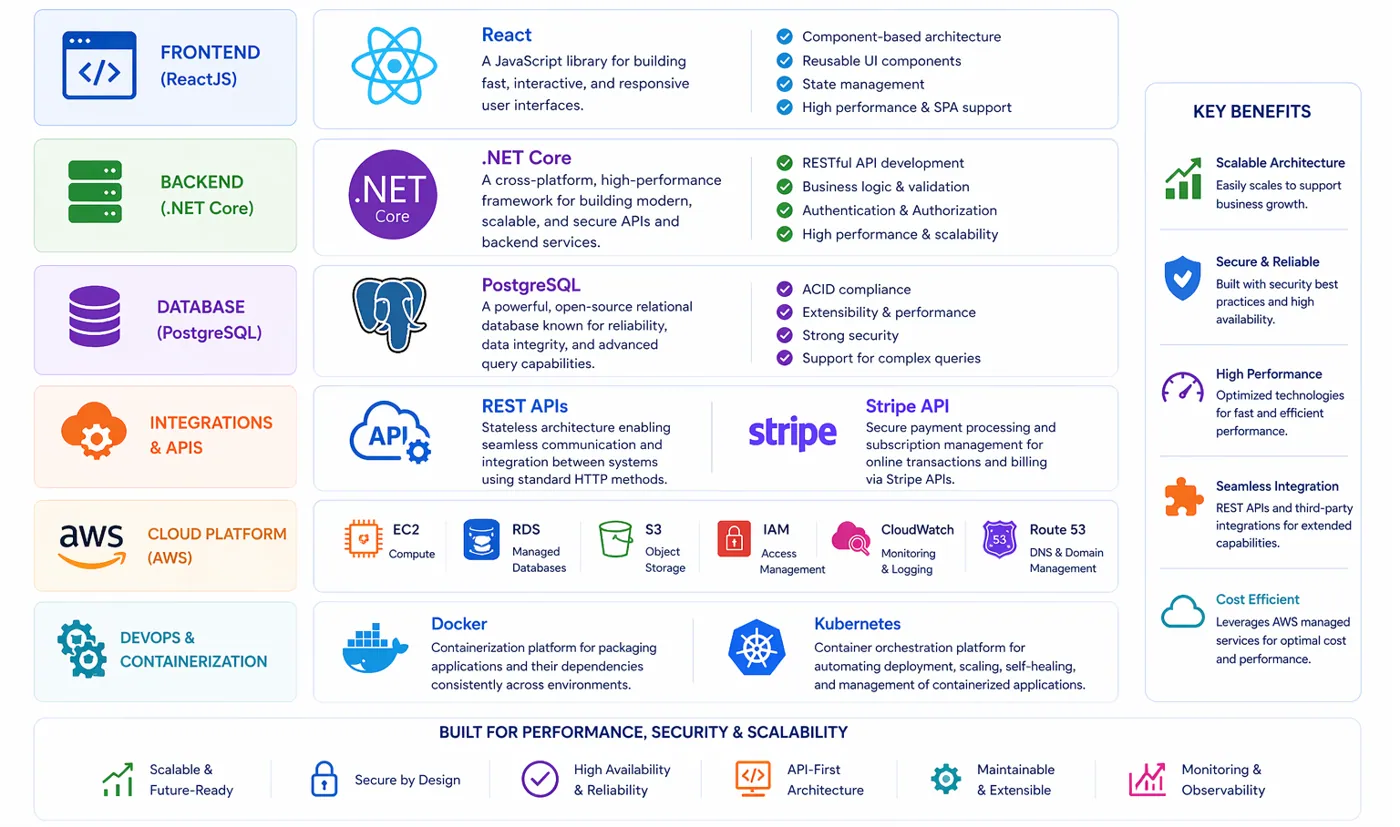
Technologies Used
Key Outcomes
The implementation enabled the client to successfully launch a scalable SaaS product with a subscription-based revenue model. It streamlined customer onboarding, improved operational efficiency, and reduced infrastructure costs through optimized resource utilization.
The platform’s architecture supported rapid feature deployment and continuous enhancements, allowing faster time-to-market. Additionally, improved user experience and real-time insights contributed to higher user engagement and overall product adoption.
Conclusion
The SaaS & Product Engineering solution successfully transformed the client’s offering into a scalable, cloud-based product platform. By adopting a multi-tenant architecture, automated deployment pipelines, and modular design, the solution enabled efficient operations and continuous product evolution.
It improved customer experience through streamlined onboarding, reliable performance, and enhanced usability, while supporting a sustainable subscription-based business model. The platform now provides a strong foundation for future expansion, rapid innovation, and long-term market scalability.