
Objective
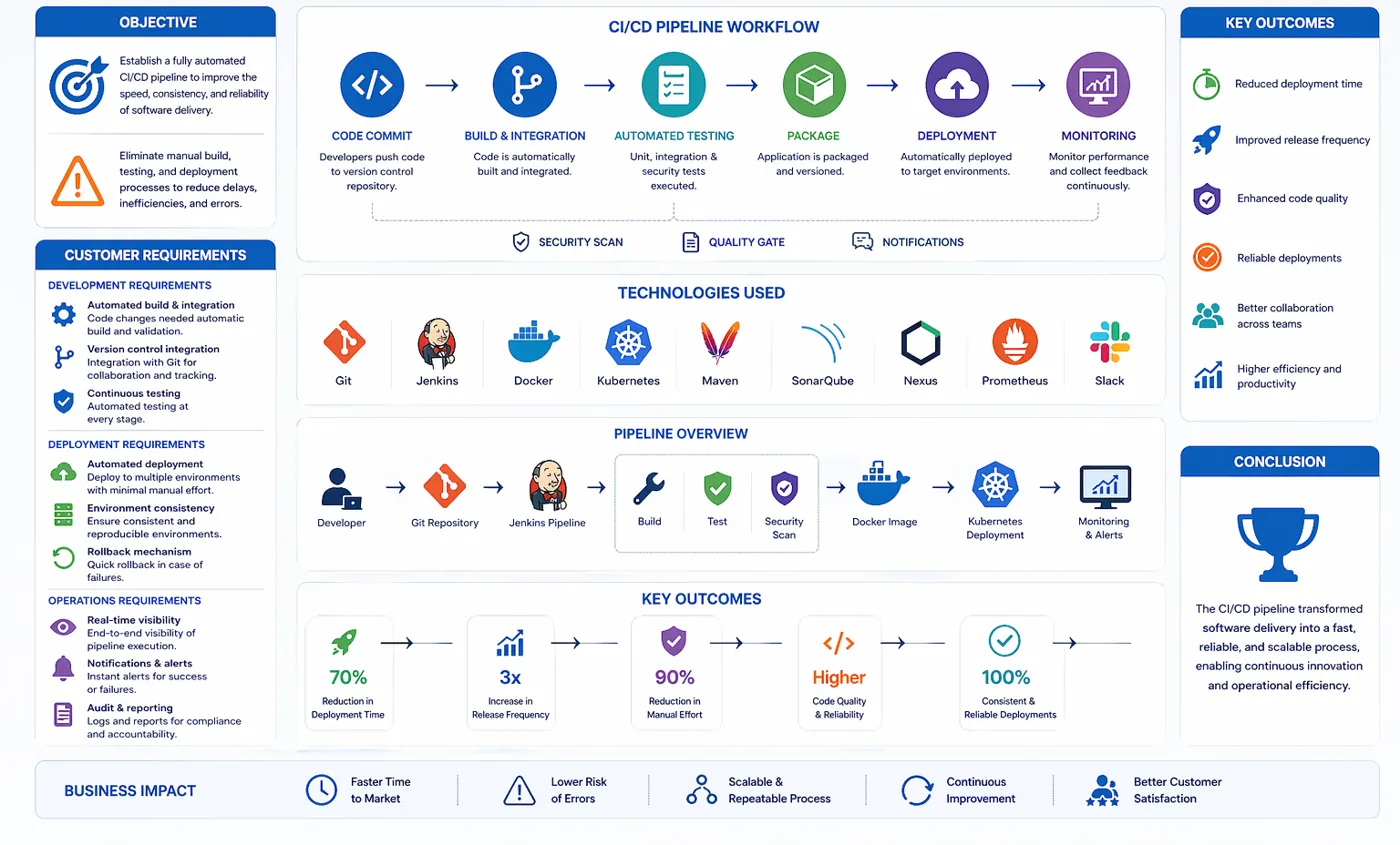
The primary objective of this project was to establish a fully automated CI/CD pipeline to improve the speed, consistency, and reliability of software delivery.
The organization faced delays due to manual build, testing, and deployment processes, leading to inefficiencies and increased risk of errors.
The goal was to enable continuous integration and continuous deployment, ensuring faster releases, improved collaboration, and higher code quality.
Customer Requirements
Development Requirements
Automated build & integration
Code changes from multiple developers were automatically triggered into a centralized build pipeline. Each commit initiated build validation, dependency checks, and artifact generation, ensuring early detection of integration issues and maintaining code stability across environments.
Version control integration
The pipeline was tightly integrated with Git-based repositories to manage source code, branching strategies, and version history. This enabled seamless collaboration, controlled releases, and traceability of every change across the development lifecycle.
Continuous testing
Automated testing frameworks were implemented to execute unit, integration, and regression tests at every stage of the pipeline. This ensured consistent code quality, reduced production defects, and provided rapid feedback to development teams.
Deployment Requirements
Automated deployment
Applications were automatically deployed through the CI/CD pipeline after successful build and testing stages. This eliminated manual intervention, reduced deployment errors, and ensured faster and consistent releases across environments.
Multi-environment support
The pipeline was configured to support development, staging, and production environments with controlled promotion workflows. This enabled proper validation at each stage and ensured stable, reliable releases to production.
Rollback capability
Automated rollback mechanisms were implemented to quickly revert to previous stable versions in case of failures. This minimized downtime, reduced risk, and ensured business continuity during deployments.
Monitoring & Security
Real-time monitoring
The pipeline was integrated with monitoring tools to track build status, deployment health, and application performance in real time. This enabled faster issue detection, proactive alerting, and continuous visibility across the delivery lifecycle.
Secure pipeline
Security checks were embedded at every stage of the pipeline, including code scanning, access control, and vulnerability assessment. This ensured safe deployments, protected sensitive data, and maintained compliance with security standards.
Our Solution
We designed and implemented a comprehensive CI/CD automation pipeline that seamlessly integrates development, testing, and deployment into a unified workflow. The solution was built to automate the entire software delivery lifecycle—from code commit to production release—ensuring consistency, reliability, and faster turnaround times.
By incorporating continuous integration, automated testing, and controlled deployment strategies, the pipeline enabled rapid validation of code changes while maintaining high quality standards. The architecture also supported scalability, multi-environment deployments, and real-time monitoring, providing complete visibility and control over the release process.
Continuous Integration
Code changes were automatically integrated and built on every commit through a centralized pipeline. This ensured early detection of issues, maintained code consistency, and reduced integration conflicts.
Automated Testing
Comprehensive testing frameworks executed unit, integration, and regression tests at each stage. This improved code quality, reduced defects, and provided rapid feedback to development teams.
Continuous Deployment
Applications were automatically deployed across development, staging, and production environments. This accelerated release cycles while ensuring consistency and reliability in deployments.
Containerization
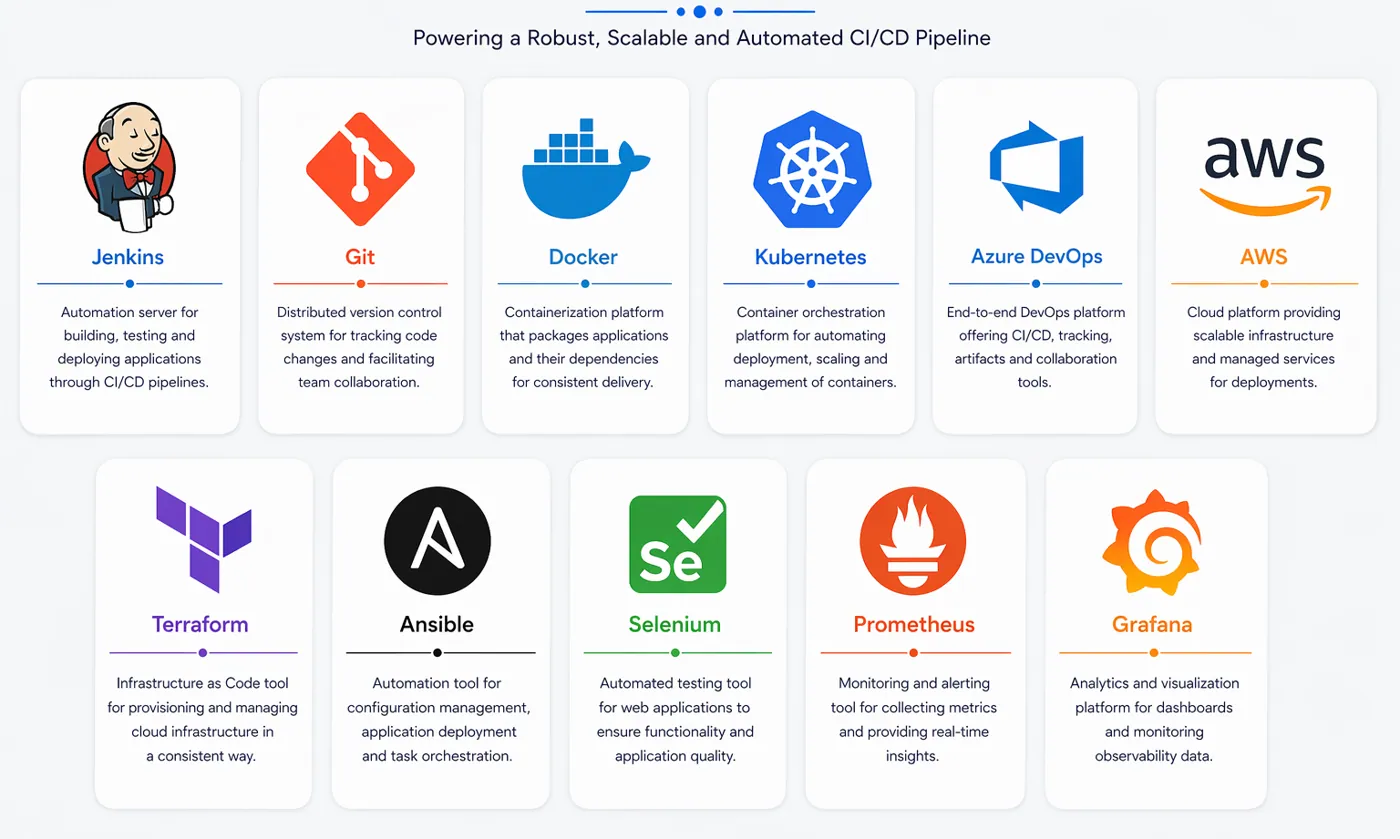
Applications were containerized using Docker to ensure consistent environments across development and production. This improved scalability, portability, and simplified deployment management.
Monitoring & Logging
Real-time monitoring and centralized logging were implemented to track system performance and pipeline health. This enabled proactive issue detection and faster resolution.
DevSecOps
Security practices were embedded throughout the pipeline, including code scanning and access controls. This ensured secure, compliant, and risk-free software delivery.
Technologies Used
Key Outcomes
The implementation significantly improved software delivery efficiency by reducing deployment time and enabling faster, more frequent release cycles. Automated workflows minimized manual intervention, reducing errors and ensuring consistent, reliable deployments across environments.
Continuous integration and testing enhanced code quality by identifying issues early in the development lifecycle, leading to fewer production defects. Additionally, real-time monitoring and streamlined processes improved team collaboration, increased visibility, and strengthened overall operational performance.
Conclusion
The implementation of the CI/CD automation pipeline successfully transformed the organization’s software delivery process into a streamlined, efficient, and reliable system. By eliminating manual bottlenecks and introducing end-to-end automation, the solution improved deployment speed, consistency, and overall code quality.
With enhanced visibility, integrated testing, and scalable deployment practices, the organization is now better equipped to deliver updates faster, respond to changing business needs, and maintain a stable production environment. The pipeline provides a strong foundation for continuous improvement and future DevOps maturity.