
Objective
The primary objective of this project was to design and implement a unified integration platform that connects multiple enterprise systems, including ERP, CRM, third-party APIs, and legacy applications. The organization was facing significant challenges due to disconnected systems, leading to data silos, manual data transfers, and inconsistent reporting across departments.
The goal was to establish a centralized, API-driven architecture that enables seamless and real-time data exchange between systems. This approach improved operational efficiency, eliminated redundancies, and ensured consistent and reliable data across the organization.
Additionally, the solution was designed as a scalable and secure integration layer capable of supporting future system expansions. By reducing dependency on manual processes and enabling flexible system connectivity, the platform enhanced overall business agility and readiness for growth.
Customer Requirements
Integration Requirements
Multi-system integration
The platform was designed to enable seamless connectivity between ERP, CRM, and third-party applications. This ensured consistent data flow and unified operations across all business functions.
Real-time data synchronization
Data was synchronized in real time across systems to eliminate delays and maintain consistency. This enabled accurate, up-to-date information for operational and strategic decision-making.
API standardization
A unified API structure was implemented to ensure consistent and reliable communication between systems. This simplified integration, reduced development complexity, and improved maintainability.
Operational Requirements
Elimination of manual data entry
Manual data transfers between systems were causing delays and errors. The platform automated data exchange workflows, improving efficiency, accuracy, and reducing operational overhead.
Scalability
The integration platform was designed to support the onboarding of additional systems and services. This ensured long-term flexibility and the ability to scale with evolving business requirements.
High availability
Continuous system uptime was critical for business operations. The solution was built with fault-tolerant architecture and reliable infrastructure to ensure consistent availability.
Security & Compliance Requirements
Secure data exchange
Data transferred between systems was secured using encryption protocols to protect information in transit. This ensured compliance with security standards and safeguarded sensitive business data.
Access control and authentication
Role-based access control and secure authentication mechanisms were implemented across the platform. This ensured only authorized users and systems could access critical data and services.
User Experience
Centralized monitoring dashboard
A unified dashboard was implemented to provide real-time visibility into system integrations, data flows, and API performance. This enabled quick identification of issues and improved overall operational control.
Error tracking and alerts
The platform included automated error detection and alert mechanisms to notify users of integration failures. This ensured timely intervention, reduced downtime, and improved system reliability.
Our Solution
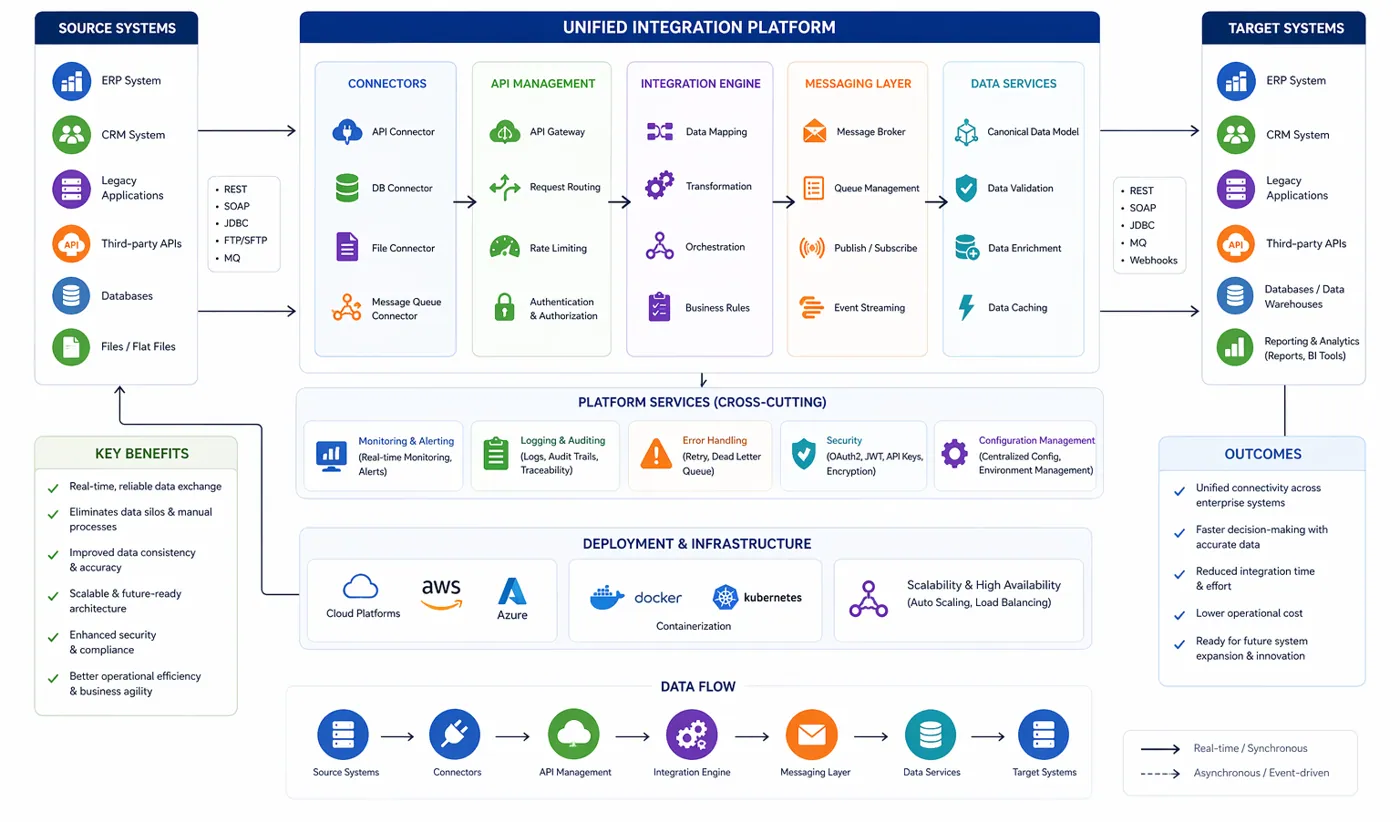
We developed a centralized integration platform that acts as a middleware layer, enabling seamless communication between multiple enterprise systems through standardized APIs and real-time data processing.
Unified API Layer
A standardised API layer enabled consistent, reliable communication between ERP, CRM and other business systems.
Integration Engine
Connectors and data mappings moved information between systems automatically, removing manual data transfers.
Real-Time Synchronisation
Event-driven synchronisation kept records consistent across every connected platform.
Monitoring & Alerts
A central dashboard tracked integration health, with automated alerts when errors occurred.
Security & Access Control
Encrypted data exchange, secure authentication and role-based access protected business data.
Scalable Architecture
New systems can be onboarded to the platform without redesigning existing integrations.
Technologies Used
Key Outcomes
The platform connected previously isolated systems into a unified, API-driven ecosystem, eliminating manual data transfers and keeping data consistent in real time.
Centralised monitoring and alerts improved reliability, while the scalable integration layer makes it easier to add new systems as the business grows.
Conclusion
The enterprise integration platform gave the organisation a single, dependable way for its systems to share data. It reduced operational effort, improved data accuracy and created a foundation for future digital initiatives.